Hi, this is CoinFirstStep. A crypto liquidation price is the price where your futures position's margin falls to the maintenance margin it needs, so the exchange closes the position for you. On Binance, that price is checked against the mark price, not the last traded price, and the higher your leverage, the closer it sits. On an isolated position, it's always a little closer than "1 divided by your leverage".
This guide shows why Binance uses the mark price, how the liquidation price is calculated with 5x, 10x and 20x examples, what happens step by step, and what liquidation heatmaps really show.
20% commission rebate
Referral link: you get a 20% commission rebate on your trading fees (disclosure).
At a glance
| What triggers it | Margin falls below the maintenance margin |
|---|---|
| Price used | The mark price |
| 20x isolated long, BTCUSDT | Liquidated about 4.6% below entry, not 5% |
| What you lose | In isolated margin, at most that position's margin |
| Heatmaps | Estimates from third-party models, not exchange data |
1. What is liquidation in crypto futures?
When you open a futures position with leverage, you put up only part of its value as margin. Each position also needs a minimum amount of margin to stay open, called the maintenance margin. If losses eat into your margin until it falls below that minimum, the exchange closes the position. That forced close is liquidation.
| Margin | The part of the position's value you put up yourself |
|---|---|
| Maintenance margin | The minimum margin the position needs to stay open |
| Liquidation price | The price where your margin falls to that minimum |
The price where this happens is your liquidation price. Binance shows it next to your open position, and it moves if you add margin to the position or make the position bigger. Understanding how it's set helps you choose leverage before you open a trade, not after.
2. Liquidation follows the mark price
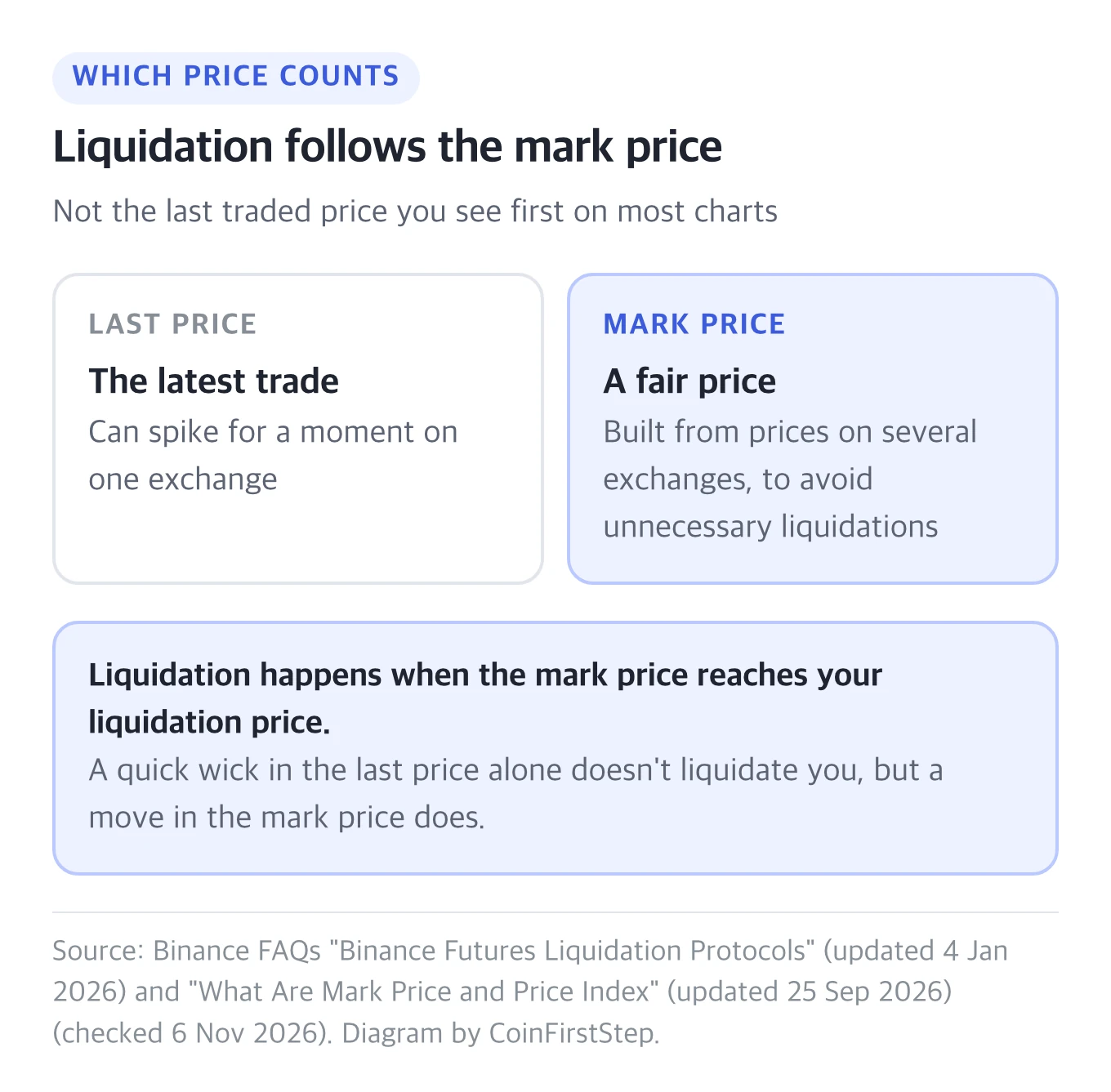
Binance's FAQ says liquidation occurs when the mark price hits your liquidation price. The mark price is built around a price index of spot prices on several exchanges, so that a brief spike on one market doesn't liquidate traders unnecessarily. That's why a quick wick on the chart doesn't always trigger liquidation, but a real move does. The unrealized loss that eats into your margin in this check is also measured at the mark price.
3. How the liquidation price is calculated
Binance publishes the full formula in its FAQ. For one isolated position with no extra margin added, it simplifies to:
▣ Isolated margin, one position
Long: liquidation price = entry × (1 − 1/leverage) ÷ (1 − maintenance margin rate)
Short: liquidation price = entry × (1 + 1/leverage) ÷ (1 + maintenance margin rate)
Here's what that gives for BTCUSDT at an entry of 80,000 USDT, using its lowest maintenance margin rate of 0.40% (as of 7 November 2026):
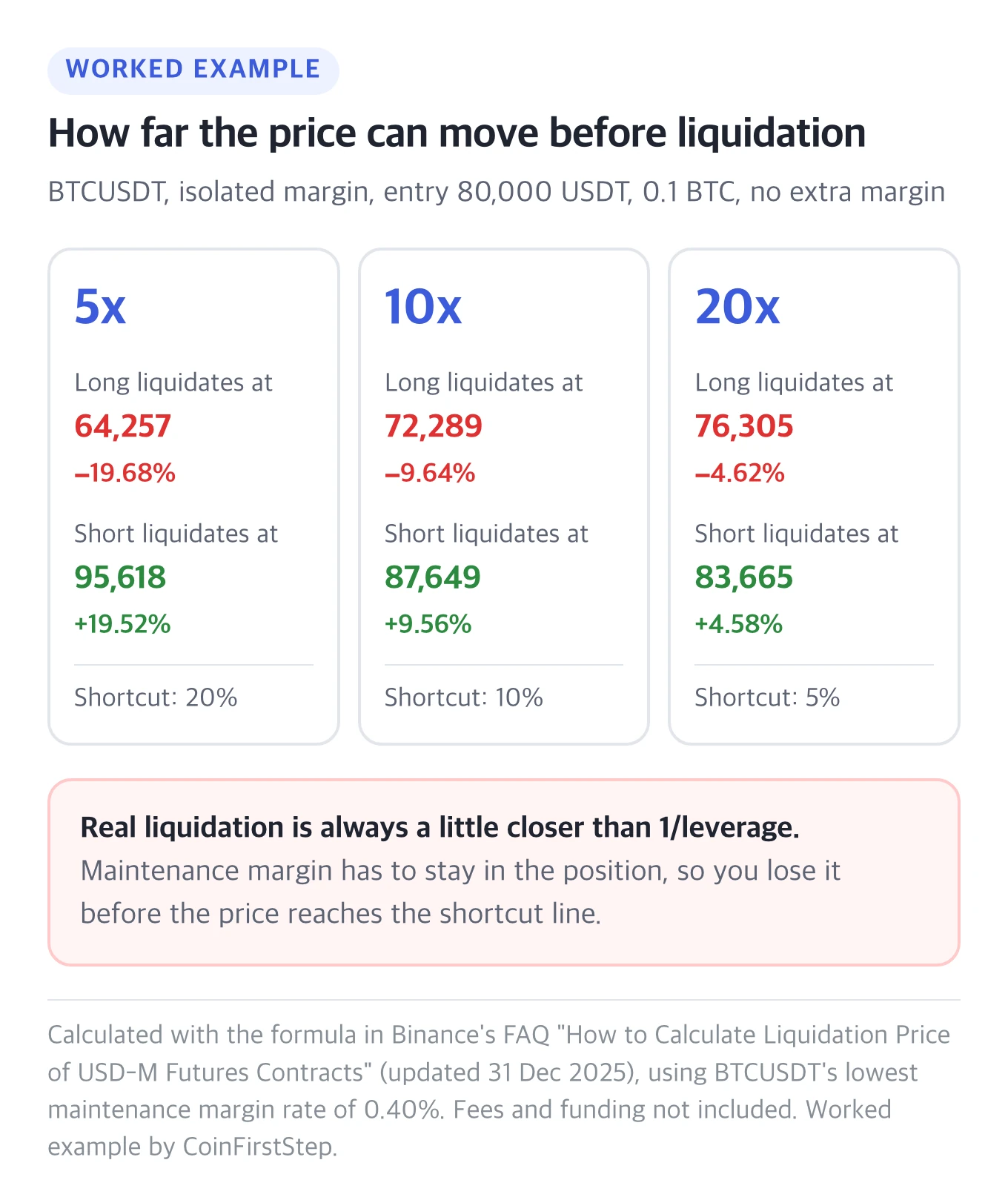
The common shortcut says a 20x long is liquidated after a 5% drop. With Binance's formula, it's 4.62%, because the maintenance margin has to stay in the position. In this example, that's 76,305 instead of 76,000: about 305 USDT of price room you don't get. Positions above 300,000 USDT move into higher maintenance margin tiers on BTCUSDT, which brings the liquidation price closer still. Fees and funding payments aren't included here, so the number on your screen can differ slightly.
4. Isolated vs cross margin
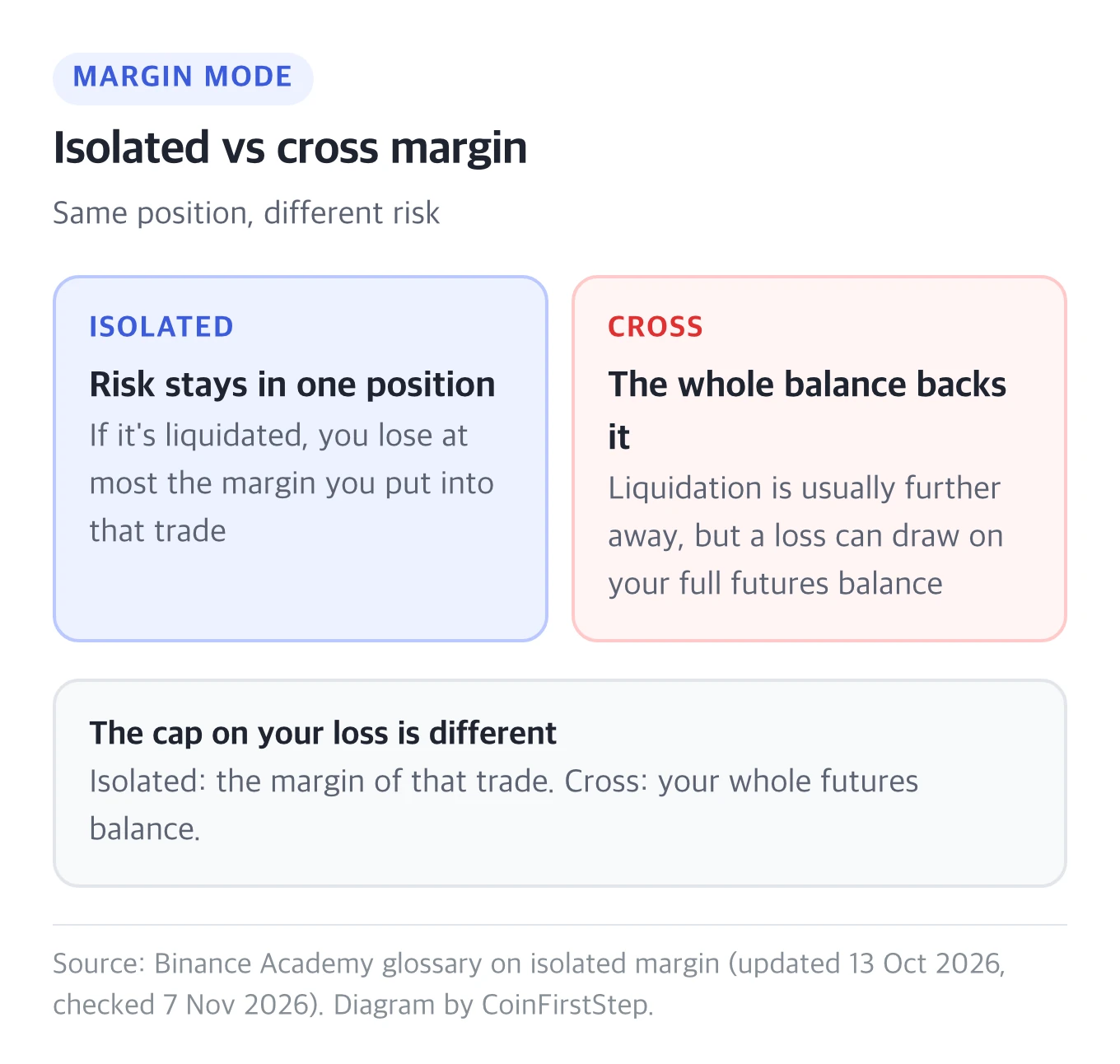
In cross margin, your whole futures balance supports every position, so the liquidation price usually sits further away than in isolated margin. The trade-off is that one losing position can drain the entire balance. Isolated margin limits the damage to the margin you put into that trade. In cross margin, the liquidation price you see also shifts as your other positions gain or lose, because they share the same balance.
5. What happens when you're liquidated
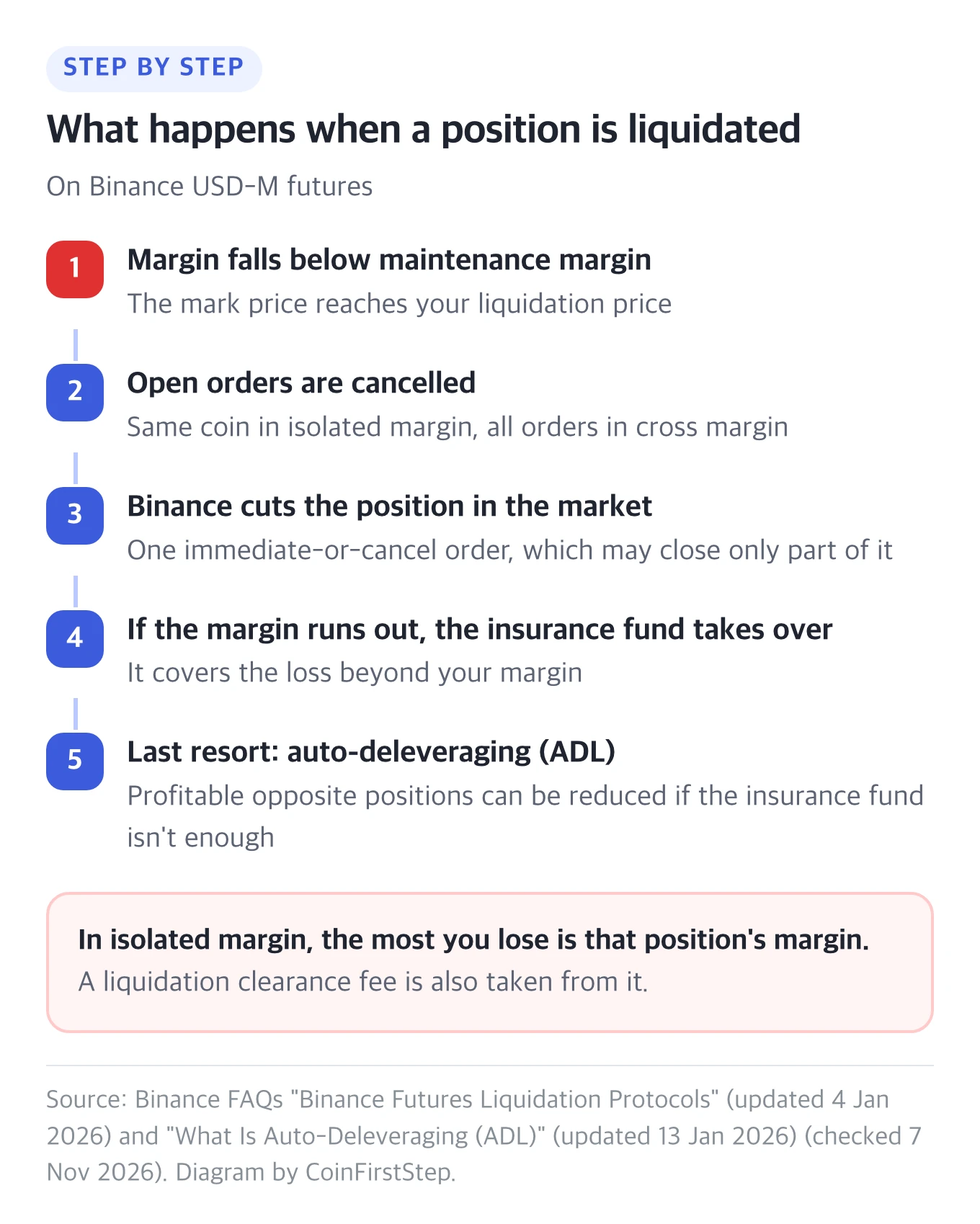
Binance first cancels your open orders: in isolated margin, those in the same coin; in cross margin, all of them. It then tries to cover the margin shortfall without closing the whole position, using one large immediate-or-cancel order (it fills what it can at once and cancels the rest), and stops if what's left meets the maintenance margin again. A liquidation clearance fee is taken from the margin of a liquidated position, so it costs more than the price move alone. If the margin runs out completely, the position is bankrupt and the insurance fund takes it over and covers the loss. Only if the insurance fund can't take it does auto-deleveraging (ADL) reduce profitable positions on the other side.
6. What liquidation heatmaps show
| What they are | Charts of price levels where many positions might be liquidated |
|---|---|
| Where the data comes from | Third-party models that estimate leverage and entry prices |
| What the makers say | CoinGlass calls its map a relative intensity indicator, and says actual liquidations may be lower |
| How to use one | As a rough map of crowded levels, not as exchange data |
Heatmaps are estimates. Exchanges don't publish everyone's liquidation prices, so these tools estimate them from trading data and assumptions about how much leverage traders use. Treat claims that price is "pulled" toward liquidation clusters with caution: the model behind the map isn't public. For data the exchange does publish, see open interest and the funding rate.
7. How to stay away from your liquidation price
| Lower leverage | Moves the liquidation price further away |
|---|---|
| Isolated margin | Caps the loss at the margin you chose |
| A stop-loss before the liquidation price | Lets you exit on your terms first |
| Check the liquidation price right after opening | Fees, funding and tiers can make it differ from your own math |
The mistake I see most often is adding more margin to a losing position just to push the liquidation price away. It delays liquidation but puts more money at risk on a trade that's already going against you. Decide where you're wrong before you enter. If you're new to futures, how a first futures trade works on Binance shows where the liquidation price appears, and you'll need a verified Binance account first.
Crypto prices are volatile, and leveraged futures can lose your whole margin quickly. This is an explainer, not investment advice.
8. Crypto liquidation price FAQ
Why wasn't I liquidated when the price touched my liquidation price?
Binance uses the mark price, not the last price. A brief spike in the last price may not move the mark price far enough (see section 2, Liquidation follows the mark price).
Can I lose more than my margin?
In isolated margin, the most you lose is that position's margin: if the close goes past the point where the margin runs out, the insurance fund covers the rest (see section 5, What happens when you're liquidated). In cross margin, losses can draw on your whole futures balance.
Does 10x leverage mean I'm liquidated after a 10% move?
Close to it, but sooner. On an isolated BTCUSDT position at the lowest tier, a 10x long is liquidated after a drop of about 9.6% (see section 3, How the liquidation price is calculated).
That covers how a crypto liquidation price works and how far away it really is.
Thanks for reading!