Hi, this is CoinFirstStep. The funding rate is a payment between longs and shorts on perpetual futures that keeps the contract's price close to the spot price. When it's positive, longs pay shorts; when it's negative, shorts pay longs.
You pay or receive it only if you hold a position at the funding time. This guide explains what the funding rate in crypto futures is, how Binance sets it, what it costs on a real position, and what a full year of Bitcoin funding looked like.
20% commission rebate
Referral link: you get a 20% commission rebate on your trading fees (disclosure).
At a glance
| What it is | A payment between longs and shorts on perpetual futures |
|---|---|
| Positive rate | Longs pay shorts |
| Negative rate | Shorts pay longs |
| How often | Every 8 hours by default; most Binance contracts every 4 hours (as of 6 November 2026) |
| Usual rate | 0.01% per 8 hours (0.005% on a 4-hour contract) |
| Who pays | Only traders holding a position at the funding time |
1. What is the funding rate in crypto?
A perpetual futures contract has no expiry date, so nothing forces its price to meet the spot price. The funding rate does that job. When the contract trades well above spot, the rate rises above 0.01% and longs pay more, which makes holding longs less attractive and pulls the price back down. When it trades well below spot, the rate turns negative and shorts pay longs. A small fixed interest part keeps the rate positive even when the contract sits only slightly below spot.
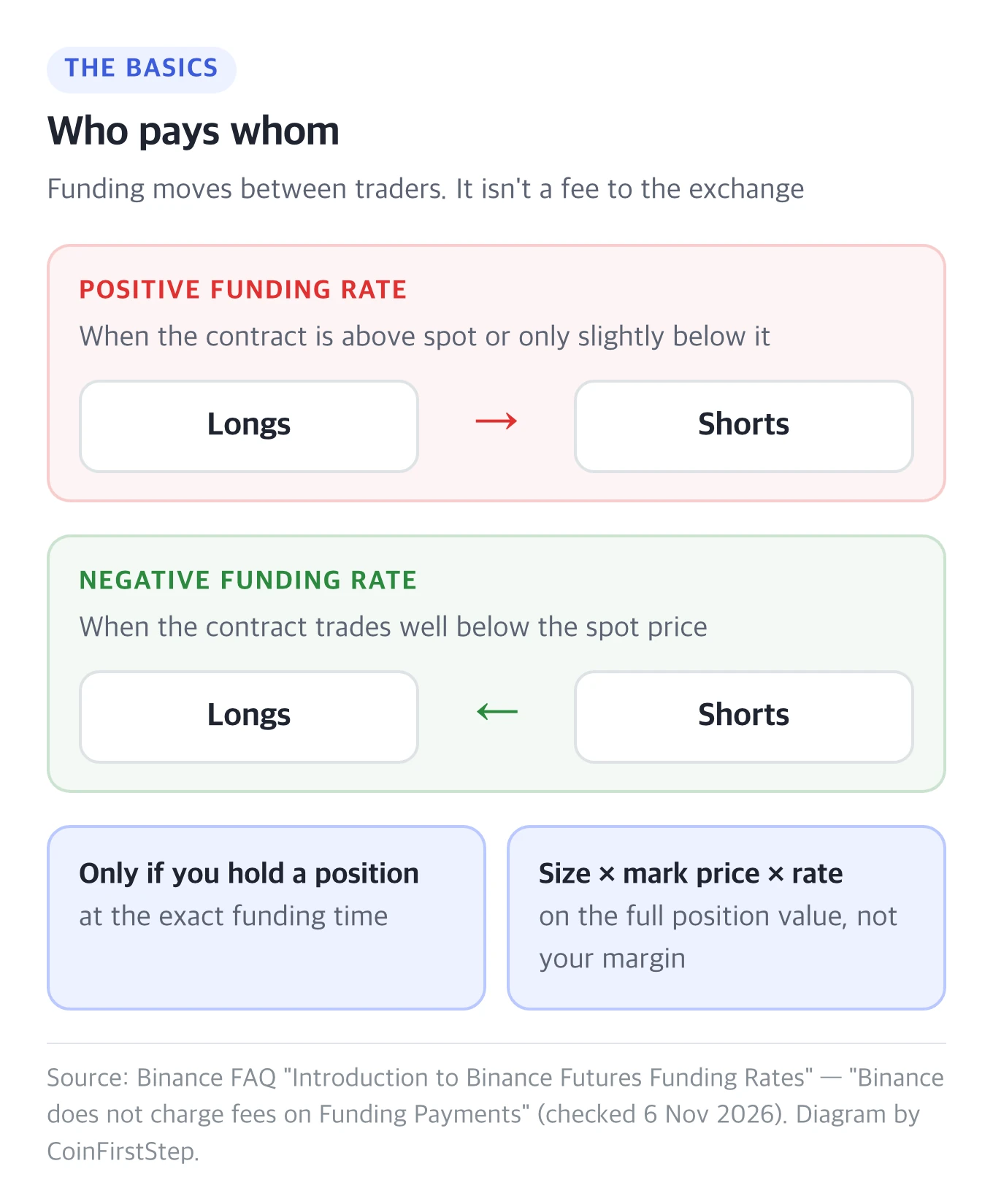
Binance's own FAQ says it doesn't charge fees on funding payments: the money moves directly between traders. The amount is your position value times the rate, using the full position value, not just your margin.
2. How Binance sets the funding rate
Binance builds the rate from two parts: a premium that measures how far the contract is from the spot price, and a fixed interest part. The interest part is 0.01% per 8 hours (0.03% a day) by default.
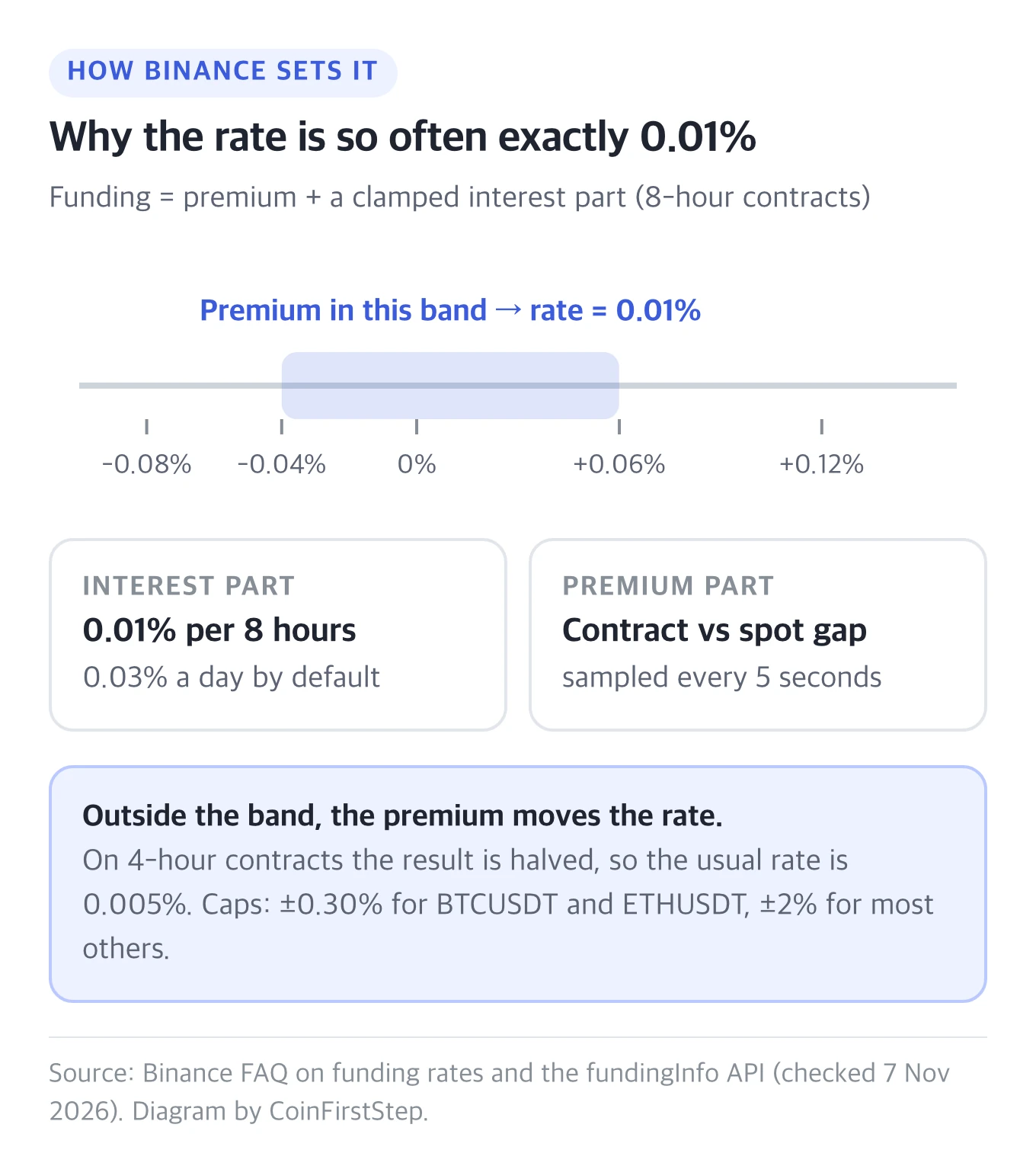
The formula clamps the interest part, so whenever the average premium over the period stays between −0.04% and +0.06%, the rate comes out at exactly 0.01%. That's why you see 0.0100% so often. Outside that band, the premium takes over.
On a 4-hour contract, Binance divides the whole result by two, so the usual rate there is 0.005%, not 0.01%. Each contract also has a cap and a floor: ±0.30% for BTCUSDT and ETHUSDT, and ±2% for most other contracts.
3. When the funding rate is paid
| Default schedule | Every 8 hours: 00:00, 08:00 and 16:00 UTC (05:30, 13:30 and 21:30 IST) |
|---|---|
| Other schedules | As of 6 November 2026, 434 of Binance's 565 USD-M perpetuals used a 4-hour schedule, 130 used 8 hours and 1 used 1 hour |
| BTCUSDT | 8 hours |
| Schedule changes | A contract moves to 1 hour after a funding hits its cap or floor, and back to 4 hours after 16 hourly rates in a row stay within ±0.025% |
| Where to check | The rate and countdown sit above the futures chart; Data → Futures Data lists every contract's real-time and past rates |
If you close your position before the funding time, you neither pay nor receive anything for that period. Binance notes that the actual transfer can be off by up to 15 seconds, so don't count on closing in the last moments.
The rate you see before the funding time is an estimate built from the premium so far. It's fixed only at the funding time. A 4-hour contract pays six times a day instead of three, but each rate is scaled to 4 hours, so compare contracts by their rate per day, not per funding time.
4. A worked example
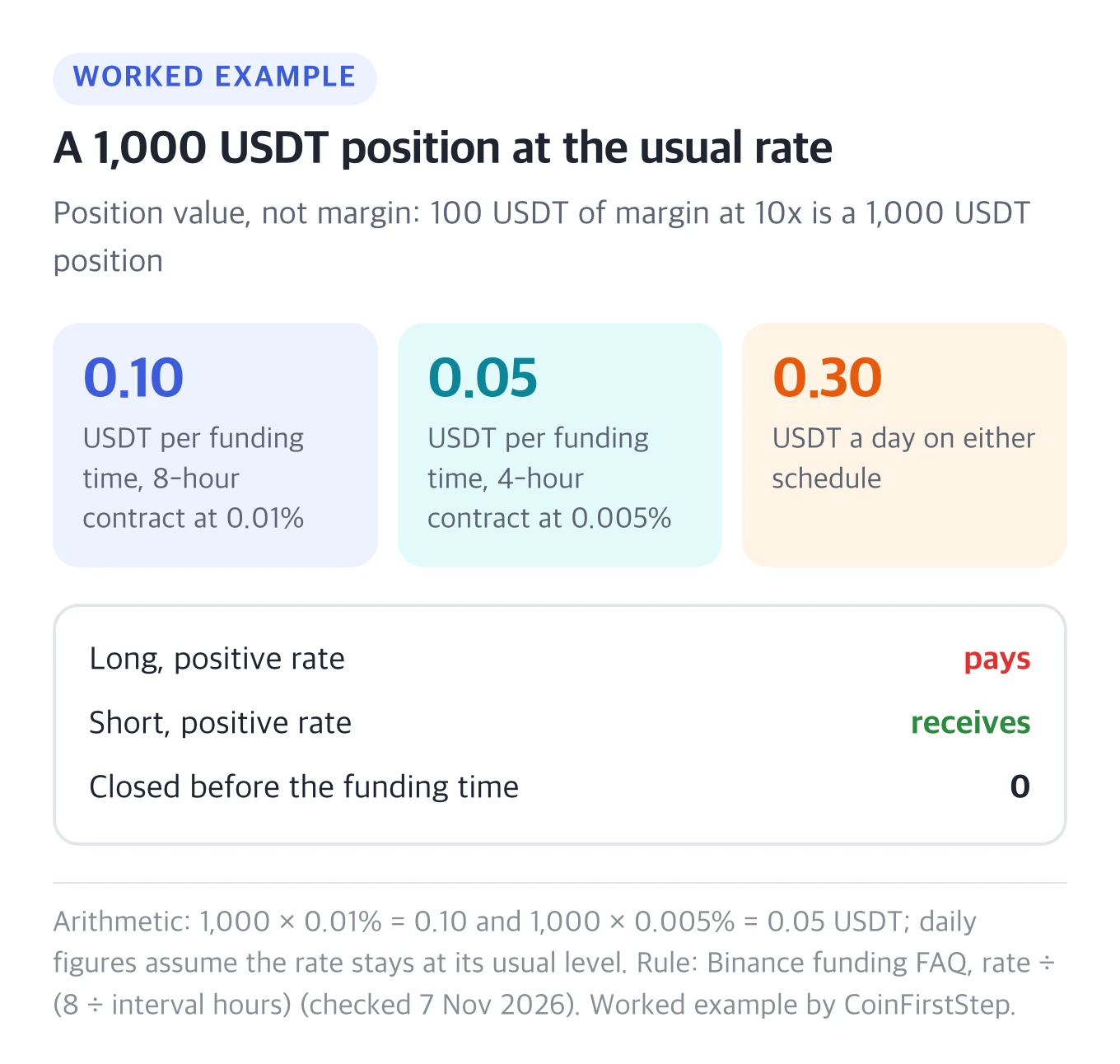
Say you hold a 1,000 USDT long position, for example 100 USDT of margin at 10x leverage. On an 8-hour contract at 0.01%, you pay 0.10 USDT at each funding time, or 0.30 USDT a day if the rate stays the same. On a 4-hour contract at its usual 0.005%, you pay 0.05 USDT six times a day: the same 0.30 USDT.
Measured against your margin, funding grows with leverage. That 0.10 USDT is 0.01% of the position but 0.1% of the 100 USDT margin, every 8 hours. If you're new to futures, how a first futures trade works on Binance covers margin and leverage step by step. Futures need a verified account, so if you don't have one yet, start with the step-by-step sign-up guide.
5. A year of real Bitcoin funding on Binance
This chart shows every BTCUSDT funding rate on Binance from November 2025 to November 2026 (an 8-hour contract), averaged by day, under the Bitcoin price.
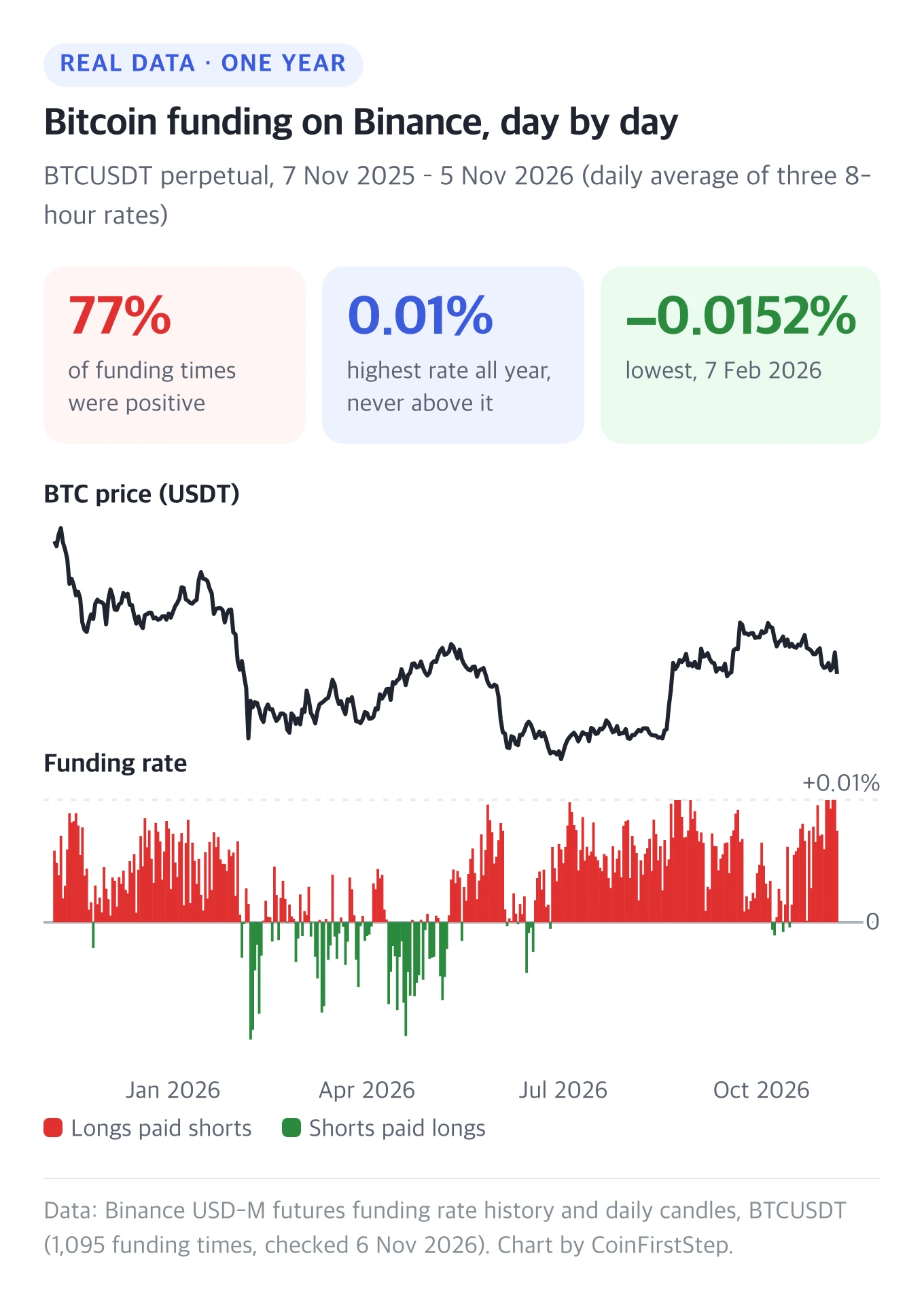
Three things stand out:
Funding never went above 0.01%. In 1,095 funding times, the highest rate was exactly 0.01%, reached 96 times. The premium never pushed the rate past the band from section 2, How Binance sets the funding rate. Most of the time it sat just below: 750 of the 1,095 rates were between 0 and 0.01%, which means the contract traded slightly below spot while longs still paid.
Longs usually paid. 77% of funding times were positive. Added up, a long held all year at a constant position value would have paid about 3.5% of that value.
Negative funding came in one main stretch. 249 of the 1,095 rates (23%) were negative, and 155 of those fell between February and April 2026. The low was −0.0152% on 7 February 2026.
This is one year of history for one contract. It shows how funding behaves, not where the price goes next.
6. How to read the funding rate
| Rate at 0.01% (0.005% on 4 hours) | The contract is close to spot; this is the default level |
|---|---|
| Above 0.01% | Longs are paying more to hold; the contract trades above spot |
| Between 0 and 0.01% | The contract trades a little below spot; longs still pay, but less |
| Negative rate | Shorts are paying longs; the contract trades well below spot |
| Rate near its cap | An extreme imbalance; the schedule may switch to 1 hour |
Funding tells you how crowded one side is, not which way the price will go. In section 5, A year of real Bitcoin funding on Binance, the price fell to its lowest close at the end of June 2026 while funding stayed positive, so I read funding next to price and open interest, never on its own. For the buying and selling behind a move, see CVD (cumulative volume delta).
Crypto prices are volatile, and futures with leverage can lose money quickly. This is an explainer, not investment advice.
7. Funding rate FAQ
Does Binance keep the funding fee?
No. See section 1, What is the funding rate in crypto?
Do I pay funding when I buy coins on spot?
No. Funding applies only to perpetual futures positions held at the funding time.
Can I avoid funding?
Only by not holding a position at the funding time. If you close before it, you neither pay nor receive for that period (allow for the 15-second timing gap in section 3, When the funding rate is paid).
Is funding charged on my margin or my position?
On your position value. See section 4, A worked example.
Is a negative funding rate good for longs?
Longs receive payments while it's negative, but that's small next to price moves. It doesn't make a long position safer.
That covers what the funding rate in crypto futures is and how to read it.
Thanks for reading!